



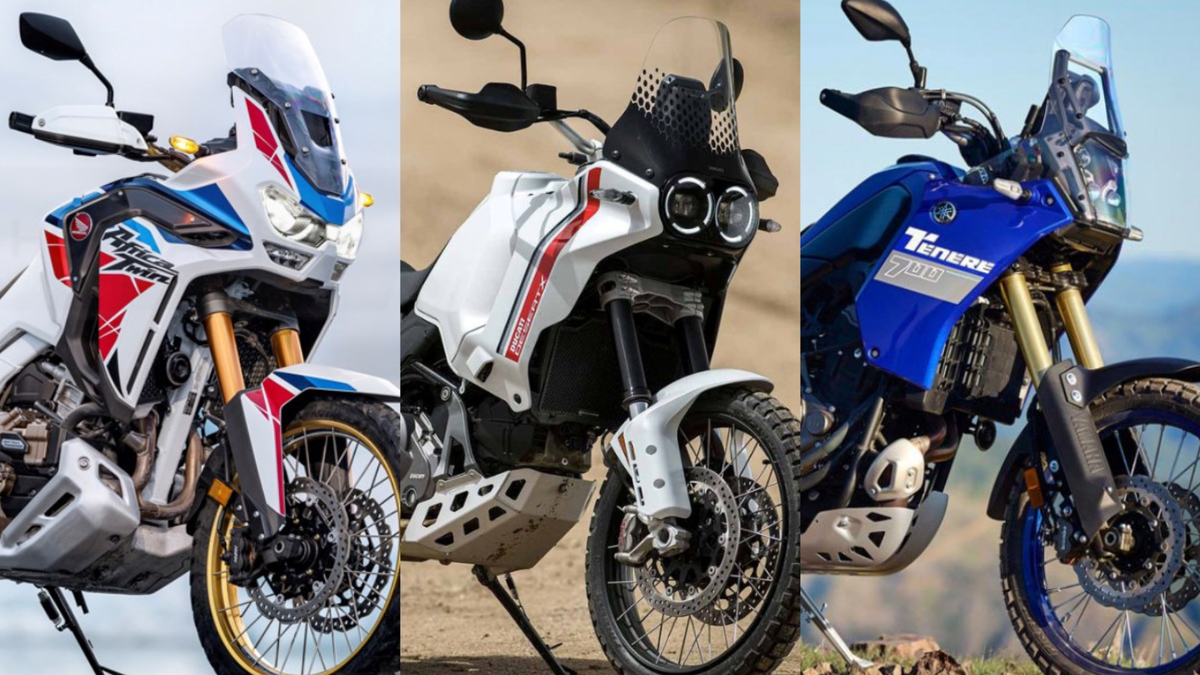
Choosing your first adventure bike can feel overwhelming, especially when every model claims to offer the “go anywhere” experience. Many beginners start by looking at the big 850cc machines because they look like what adventure riders use. But once you actually sit on one, the height and weight hit you immediately. That’s often the moment riders realize they need to rethink what they truly want from an ADV.
Adventure riding isn’t a single category—it’s a spectrum with very different needs. Some riders want something light, flickable, and confidence-building on gravel or tight trails. Others prioritize long-distance comfort, stability, and wind protection for hours on the road. And a lot of beginners fall somewhere right in the middle, wanting a bike that can handle both pavement and dirt without feeling intimidating.

Entry-level adventure bikes deliver the versatility and capability that made ADV popular, scaled to beginner-friendly sizes and prices. Source
Entry-level adventure bikes exist exactly for this reason. They take the versatility of the ADV category and scale it into sizes that are easier to manage. Power delivery, seat height, and weight are all designed with newer riders in mind. That makes them a smarter starting point than jumping straight to a towering, fully loaded flagship model.
This guide will help you figure out which beginner ADV fits your riding style and comfort level. The best first adventure bike isn’t the biggest or most powerful—it’s the one you can grow with and enjoy from day one.
Which Adventure Motorcycle Is Right for You?
|
Your Priority |
Recommended Bike |
Why It Works |
|
Best Overall Versatile Choice |
Honda CB500X |
Proven reliability, 400km+ range, comfortable ergonomics, excellent fuel economy, manageable 830mm seat |
|
Best for Serious Off-Road |
Yamaha Ténéré 700 |
Rally-inspired design, 210mm suspension travel, 21" front wheel, genuine trail capability at 204kg |
|
Best Value |
Royal Enfield Himalayan 450 |
€5,500 entry price, modern features, switchable ABS, navigation, legitimate adventure capability |
|
Lightest & Most Manageable |
KTM 390 Adventure |
Only 172kg, advanced electronics, flickable in technical terrain, lowest weight for serious off-road |
|
Best for Shorter Riders |
Kawasaki Versys-X 300 |
815mm seat height, 184kg weight, narrow chassis, easy to flat-foot for most riders |
|
Best for Long-Distance Touring |
Suzuki V-Strom 650 |
V-twin character, 20L tank, wind protection, proven comfort, exceptional aftermarket support |
|
Best Premium Entry |
BMW G 310 GS |
German build quality, GS heritage, 3-year warranty, extensive dealer network, 169kg weight |
|
Best Modern Middleweight Option |
CFMoto 450 MT |
44hp parallel-twin, modern TFT display, comfortable upright ergonomics, advanced electronics, 420mm suspension travel, good for both on- and off-road |
What Makes a Good Beginner Adventure Motorcycle
Adventure bikes occupy a unique space between street-focused motorcycles and dedicated dirt bikes. Understanding what makes one suitable for beginners requires looking beyond simple specifications.
Seat height matters more on ADV bikes than any other category. Unlike sport bikes where you're rarely at complete stops, adventure riding frequently involves slow-speed maneuvering, off-road sections, and unpredictable terrain where confidence at stops directly affects safety. A seat height above 850mm can feel intimidating for newer riders, especially when the bike starts to tip on loose gravel.
Weight becomes critical off-pavement. A 220kg adventure bike that feels manageable on smooth tarmac turns into an anchor the moment you hit sand, mud, or steep inclines. Lighter bikes (under 200kg) allow you to muscle through challenging sections and pick the bike up when—not if—you drop it.

The best beginner ADV bikes balance on-road comfort with legitimate off-road capability without overwhelming new riders. Source
Power delivery needs to be smooth and predictable. Sudden power surges on loose surfaces can break traction instantly. The best beginner adventure bikes favor tractable low-end torque over peaky high-rev power. This makes them easier to control in technical terrain while still providing enough performance for highway cruising.
Crash protection and durability matter. You will drop an adventure bike while learning off-road skills—that's part of the process. Bikes with good crash protection, affordable replacement parts, and plastic bodywork that bounces rather than shatters reduce the financial and emotional cost of learning.
Honda CB500X
Engine: 471cc parallel-twin | Power: 47hp | Weight: 196kg | Seat Height: 830mm | Price: ~€7,200
The Honda CB500X represents the sensible choice—a motorcycle that prioritizes reliability, comfort, and versatility over aggressive adventure styling or extreme capability. Its 471cc liquid-cooled parallel-twin produces smooth, predictable power throughout the rev range, making it equally comfortable in city traffic and on unpaved forest roads.
At 196kg wet weight, the CB500X sits at the lighter end of the adventure bike spectrum. The 830mm seat height is manageable for most riders, and the narrow chassis means shorter riders can touch down more easily than the numbers suggest. The upright riding position provides excellent visibility in traffic while reducing fatigue on longer rides.

The CB500X delivers Honda reliability and comfort in a package that's genuinely manageable for newer riders. Source
For 2025, Honda updated the CB500X with revised styling, improved wind protection, and longer-travel suspension. LED lighting comes standard, as does a digital display with gear position indicator. The 19-inch front wheel strikes a balance between on-road stability and off-road capability—though this bike favors gravel roads and hard-pack dirt over serious single-track riding.
The CB500X excels as a versatile daily rider that can handle weekend adventures. Fuel economy consistently exceeds 25km/L, the 17.7-liter tank provides 400km+ range, and Honda’s reliability means minimal maintenance headaches. Service intervals stretch to 12,000km, and valve adjustments aren’t needed until 24,000km—unusually long for this category.
Yamaha Ténéré 700
Engine: 689cc parallel-twin | Power: 73hp | Weight: 204kg | Seat Height: 875mm | Price: ~€10,500
The Yamaha Ténéré 700 sits at the upper end of beginner-friendly adventure bikes—more capable and powerful than entry-level options but significantly more manageable than liter-class adventure machines. Its 689cc CP2 parallel-twin engine (shared with the MT-07) produces 73hp with strong torque delivery that excels in off-road situations.
What sets the Ténéré 700 apart is its off-road focus. The long-travel suspension (210mm front, 200mm rear), 21-inch front wheel, and rally-inspired ergonomics create a bike that genuinely excels when pavement ends. The chassis geometry favors standing-up riding, and the lightweight construction (204kg is impressive for a 700cc twin) makes it manageable in technical terrain.

The Ténéré 700's rally-inspired design and capable chassis deliver serious off-road performance in a package that's still approachable for developing riders. Source
The 875mm seat height is tall—taller than many beginners prefer—but the narrow chassis helps. Yamaha deliberately kept the bike simple: no traction control, no riding modes, no electronic suspension. Just ABS (switchable for off-road), fuel injection, and a minimalist LCD display.
The Ténéré 700 works best for riders who prioritize off-road capability and plan to develop serious trail-riding skills. It’s less comfortable for pure street riding than something like the CB500X but dramatically more capable once terrain gets challenging. If your adventure dreams involve serious dirt roads and single-track trails, the Ténéré 700 delivers without requiring expert-level skills.
Royal Enfield Himalayan 450
Engine: 452cc single-cylinder | Power: 40hp | Weight: 196kg | Seat Height: 825mm | Price: ~€5,500
The Royal Enfield Himalayan 450 represents exceptional value in the adventure category. At €5,500, it's one of the most affordable genuine adventure motorcycles from an established manufacturer. The all-new 452cc liquid-cooled single-cylinder engine produces 40hp—enough for comfortable highway riding while remaining manageable for beginners.
Royal Enfield designed the Himalayan specifically for adventure riding in challenging conditions. The engine produces strong low-end torque that makes technical riding easier, and the six-speed gearbox offers taller gearing than the previous Himalayan 411 for more relaxed highway cruising.

The Himalayan 450 delivers legitimate adventure capability and modern features at a price point that's hard to beat. Source
The 2025 Himalayan 450 comes with impressive standard equipment: switchable ABS with off-road mode, full LED lighting, a circular TFT display with turn-by-turn navigation via Bluetooth connectivity, USB charging, and Showa suspension components. The 21-inch front and 17-inch rear spoked wheels are tubeless-compatible, and the bash plate protects critical engine components.
The Himalayan 450 shines as an affordable entry point to serious adventure riding. It handles daily commuting competently, remains comfortable on multi-day tours, and delivers legitimate off-road capability for riders learning trail techniques. For the price, nothing else offers this combination of features and capability.
KTM 390 Adventure
Engine: 373cc single-cylinder | Power: 44hp | Weight: 172kg | Seat Height: 855mm | Price: ~€6,800
The KTM 390 Adventure brings Austrian engineering and serious electronics to the entry-level adventure category. At just 172kg ready to ride, it's the lightest bike on this list. That low weight combines with genuine off-road capability, advanced electronics, and aggressive styling to create an adventure bike that punches above its displacement.
The 373cc liquid-cooled single-cylinder produces 44hp with strong mid-range torque. KTM equipped the 390 Adventure with ride-by-wire throttle, multiple riding modes (Street, Offroad, optional Rally mode), lean-sensitive ABS that can be disabled for the rear wheel, and a full-color TFT display with smartphone connectivity. These electronics typically appear only on premium adventure bikes costing €12,000+.

The 390 Adventure's featherweight chassis and advanced electronics create a surprisingly capable package for technical riding. Source
The suspension features 43mm WP Apex forks with 170mm travel and a WP Apex monoshock with 177mm travel—quality components that handle aggressive off-road riding. The 19-inch front and 17-inch rear spoked wheels strike a balance between off-road traction and on-road stability. Crash protection comes standard with a bash plate and hand guards.
The 390 Adventure excels for riders who want maximum off-road capability in a beginner-friendly package. It handles technical trails competently, remains flickable in tight situations, and delivers electronics that support skill development. Just be prepared for more frequent maintenance than Japanese alternatives.
Kawasaki Versys-X 300
Engine: 296cc parallel-twin | Power: 39hp | Weight: 184kg | Seat Height: 815mm | Price: ~€6,200
The Kawasaki Versys-X 300 proves that adventure capability doesn't require big displacement. Its 296cc liquid-cooled parallel-twin delivers smooth, tractable power that's ideal for learning off-road techniques without overwhelming newer riders. At just 184kg, it's one of the lightest true adventure bikes available.
That low weight transforms how the bike feels off-pavement. On loose gravel, sand, or steep inclines where heavier bikes bog down, the Versys-X 300 remains manageable. If you drop it—and you will while learning—picking it back up doesn't require superhuman strength. The 815mm seat height is among the lowest in the adventure category, making it accessible for riders under 175cm.

The Versys-X 300's light weight and compact dimensions make it confidence-inspiring on technical terrain and easy to manage at slow speeds. Source
The engine character favors usability over excitement. Peak power arrives at a relatively low 11,500 rpm, but the real story is the torque curve—the bike pulls cleanly from low revs and delivers linear power through the midrange. This makes technical riding easier since you're not constantly managing clutch slip or hunting for the right gear.
The Versys-X 300 works brilliantly for riders prioritizing off-road learning and technical capability over highway performance. The smaller engine means motorway riding at 120km/h feels busy, but for everything else—from daily commuting to weekend trail exploration—it delivers more capability than its modest specifications suggest.
Suzuki V-Strom 650
Engine: 645cc V-twin | Power: 71hp | Weight: 216kg | Seat Height: 835mm | Price: ~€9,000
The Suzuki V-Strom 650 has been a staple of the adventure category for nearly two decades. Its 645cc 90-degree V-twin produces smooth, tractable power with strong low-end torque—exactly what adventure riding demands. At 216kg, it's heavier than smaller-displacement options but still manageable for developing riders.
What makes the V-Strom 650 special is its character. The V-twin engine delivers mechanical personality that parallel twins lack—a satisfying exhaust note, strong torque from low revs, and smooth power delivery that makes long-distance touring relaxing. The upright riding position and wind protection from the adjustable windscreen reduce fatigue on extended rides.

The V-Strom 650's proven reliability and comfortable ergonomics make it ideal for riders planning serious touring and light off-road exploration. Source
The V-Strom 650 leans toward comfort and touring over extreme off-road capability. Think 60% street, 40% light off-road—perfect for riders planning long-distance adventures on paved roads with occasional unpaved detours. Fuel economy averages 20–23km/L, and the 20-liter tank provides 400km+ range.
Aftermarket support is exceptional—luggage systems, crash bars, auxiliary lights, and comfort upgrades are readily available. Many riders keep their V-Strom 650 for years, often adding tens of thousands of kilometers without major issues.
BMW G 310 GS
Engine: 313cc single-cylinder | Power: 34hp | Weight: 169kg | Seat Height: 835mm | Price: ~€6,200
The BMW G 310 GS brings German engineering and GS lineage to the entry-level adventure category. At €6,200, it's one of the most affordable ways to enter the BMW adventure family. The 313cc liquid-cooled single-cylinder produces 34hp—modest numbers that translate to manageable, predictable power delivery perfect for learning.
At 169kg, the G 310 GS is genuinely lightweight. Combined with the 835mm seat height and narrow chassis, it feels approachable for riders of various sizes. The build quality exceeds expectations—paint finish, component selection, and overall fit rival bikes costing significantly more. BMW backs it with a three-year unlimited-mile warranty and extensive dealer network across Europe.

The G 310 GS delivers BMW build quality and GS heritage at an accessible price point for new adventure riders. Source
The engine layout is unusual—the cylinder slants backward with the crankshaft rotating "backward" relative to travel direction. This configuration creates interesting handling characteristics that work well in the adventure context. Power delivery is smooth throughout the rev range, though 34hp means highway riding above 110km/h feels busy.
The G 310 GS works best as a capable commuter with adventure styling and weekend off-road potential. It won't keep up with larger-displacement bikes on aggressive trails, but for learning off-road fundamentals and exploring unpaved roads, it delivers BMW quality at an accessible price.
CFMoto 450 MT
Engine: 449 cc parallel‑twin, liquid‑cooled, DOHC | Weight: ~175 kg (dry) | Seat Height: ~820 mm (adjustable to ~800 mm)
The CFMoto 450 MT is a modern mid-capacity adventure bike with a 449 cc parallel-twin engine producing smooth, tractable power for city riding and weekend exploration. At around 175 kg dry, it is lightweight, making slow-speed handling and off-pavement maneuvers confidence-inspiring.
The seat height of approximately 820 mm can be lowered to 800 mm for shorter riders, improving stability when stopped. Its adventure-ready chassis features KYB suspension with roughly 200 mm travel front and rear, and 21″ front / 18″ rear spoke wheels with tubeless tires for serious off-road capability.

CFMoto 450 MT: Lightweight, agile adventure bike with smooth 449 cc twin, off-road capability, and beginner-friendly ergonomics. Source
Bosch dual-channel ABS and switchable traction control provide safety on pavement while allowing off-road flexibility. Ergonomics focus on comfort with upright seating, wide handlebars, handguards, and an adjustable windshield.
The 450 MT also includes a modern TFT display with connectivity and rally-inspired styling. It is an agile, versatile ADV option that balances on- and off-road capability without overwhelming new riders.
Choosing Your First Adventure Motorcycle
Selecting from this list requires honest assessment of your intended use, physical dimensions, and budget priorities.
For serious off-road learning: The KTM 390 Adventure and Yamaha Ténéré 700 deliver genuine trail capability. The Kawasaki Versys-X 300 offers similar off-road focus in a lighter, more affordable package.
For daily commuting with weekend adventures: The Honda CB500X and Suzuki V-Strom 650 balance comfort, reliability, and versatility. They handle urban riding smoothly while remaining capable on unpaved roads.

Match your first ADV bike to your actual riding plans, not your aspirational dreams—you can always upgrade later. Source
For budget-conscious riders: The Royal Enfield Himalayan 450 delivers remarkable capability and features for the price. The BMW G 310 GS offers premium brand access at entry-level cost.
For riders planning extensive touring: The Suzuki V-Strom 650 and Honda CB500X provide comfort, range, and reliability for long-distance adventures.
Seat height matters critically for adventure bikes. If you can't touch the ground confidently, your off-road anxiety will limit skill development. Test multiple bikes in person—manufacturer specifications don't tell the whole story about how a bike actually fits.
FAQs
What seat height can I manage as a beginner?
Most riders can handle seat heights up to 850mm with practice, but confidence matters more than touching flat-footed. The narrower the chassis, the easier it is to reach the ground despite higher seat heights.
Can I tour on a small-displacement adventure bike?
Absolutely. The CB500X, Versys-X 300, and Himalayan 450 all handle multi-day tours comfortably. Smaller engines mean you'll cruise at lower speeds, but fuel economy and range often exceed larger bikes.
How much off-road capability do I actually need?
Most adventure riders spend 80%+ of their time on pavement. Unless you specifically plan regular trail riding or overlanding trips, prioritize comfort and reliability over extreme off-road capability.
Should I buy new or used for my first ADV bike?
New bikes come with warranties and known history—valuable for adventure bikes that might see challenging use. Used bikes offer better value but verify service history and inspect carefully for damage from drops.
Do I need crash bars and protection?
Yes. Adventure riding means drops will happen while learning off-road skills. Crash bars, bash plates, and hand guards protect expensive components and reduce repair costs.
What's better: parallel-twin or single-cylinder?
Twins offer smoother power delivery and less vibration, better for highway riding and comfort. Singles are lighter and often more tractable off-road but buzz at sustained high speeds. Neither is objectively better—it's preference and intended use.
Get Started
The adventure motorcycles on this list share one critical trait: they're all genuinely capable machines scaled to beginner-friendly sizes and prices. Whether you choose the Honda CB500X's reliable versatility, the KTM 390 Adventure's lightweight capability, or the Royal Enfield Himalayan 450's exceptional value, each bike will support your skill development without overwhelming you.

Your first adventure bike should build confidence while opening new roads—choose one that matches your reality, not your fantasy. Source
Start with proper training. Respect your limits while gradually pushing them. And remember that adventure riding is about the journey and exploration—not about having the biggest, most capable bike in the parking lot.
Welcome to adventure riding.






1 comment
harry
Great bike
https://bratzcollectorsvault.com/
Leave a comment
All comments are moderated before being published.
This site is protected by hCaptcha and the hCaptcha Privacy Policy and Terms of Service apply.