


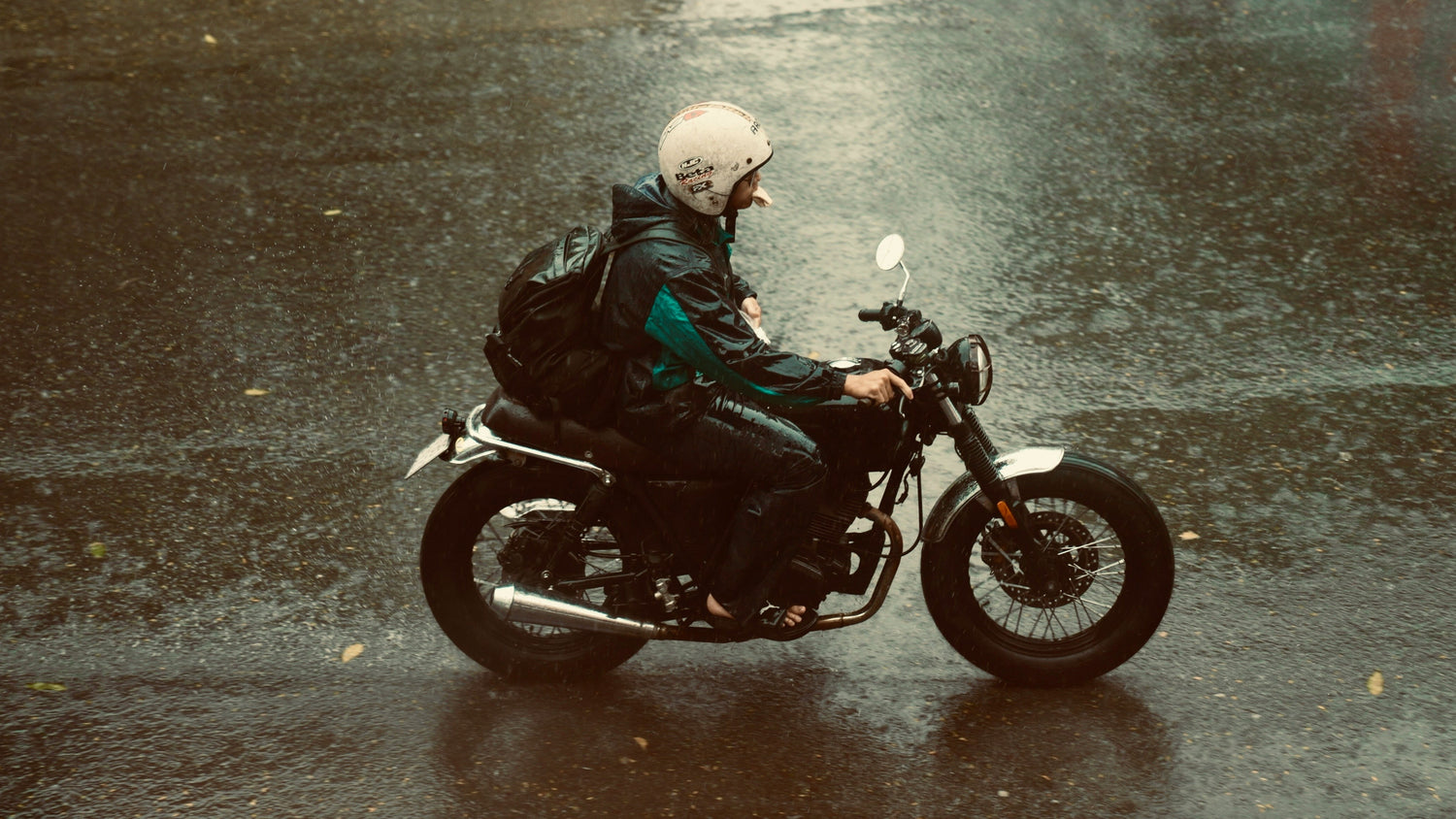
You twist the throttle coming out of a wet roundabout, the back tyre gives a tiny wriggle, and before your brain has even registered it, the bike has already trimmed the power and tucked the slide away. You barely felt it happen. That quiet, invisible save is the work of an electronic rider aid — one of several systems now built into most new motorcycles, from 300cc commuters to big adventure tourers.
For a new rider, the spec sheet that lists all of this can read like alphabet soup: ABS, TCS, IMU, ride modes, quickshifter. It's easy to either ignore the lot or assume the bike will simply ride itself. Neither is true. These systems are genuinely useful, and understanding what each one does — and just as importantly, what it can't do — will make you a calmer, more confident rider. This guide walks through the main motorcycle rider aids in plain language.
First, one idea that ties it all together
Almost every electronic aid on your bike exists to manage one thing: grip. A tyre has only so much traction to give at any moment, and that grip has to be shared between three jobs — turning, braking, and accelerating. Riding instructors often call this the "traction pie." When the pie is full, you can do a lot. But the more you use for one job, the less is left for the others.
This matters most exactly when conditions are against you. Lean the bike into a corner and a big slice of grip is already being spent on turning, so there's less available to brake or accelerate. Add rain, gravel, or cold tarmac and the whole pie shrinks. Rider aids are essentially fast, tireless assistants that watch this grip budget and step in when you're about to overspend it. They don't add grip — they help you avoid running out of it.

ABS: the brake that won't lock the wheel
Anti-lock braking, or ABS, is the most established aid and the one most worth understanding. Picture a damp morning where a car pulls out in front of you and you grab the brakes hard. Without ABS, a panic squeeze can lock the front wheel, and a locked front tyre stops steering and tends to wash out from under you. ABS senses a wheel about to lock and rapidly eases and reapplies brake pressure — many times a second — so the tyre keeps rolling and you keep steering.
The safety case is strong and well documented. An Insurance Institute for Highway Safety (IIHS) study published in 2021 compared the same motorcycle models with and without ABS and found the equipped bikes were involved in about 22 percent fewer fatal crashes. The benefit was largest on standard and cruiser models and a little smaller on sportbikes. The protection is convincing enough that the European Union has required ABS on new road motorcycles above 125cc since 2016.
It helps to know the limits, too. On loose surfaces like gravel or deep sand, ABS can actually lengthen stopping distance, which is why many off-road-capable bikes let you switch it off at the rear. And no braking system shortens the laws of physics: ABS reduces the risk of a locked-wheel fall, but it can't replace looking far ahead and braking early.
Traction control: keeping the rear from spinning up
If ABS manages grip under braking, traction control (often shown as TC or TCS) manages it under acceleration. Think of pulling out of a wet junction, or feeding in the throttle as you stand the bike up out of a bend. If you ask for more drive than the rear tyre can put down, the wheel starts to spin faster than the bike is actually moving.
Traction control catches this by comparing front and rear wheel speeds. When the rear starts to outrun the front, the system trims engine power — by softening the throttle, cutting fuel, or retarding the ignition — just enough to let the tyre hook back up. On most bikes you can adjust how early it intervenes, or turn it off entirely.
Like ABS, it has a clear boundary. Traction control can only work with the grip that's there; if the surface simply has none, the electronics can't invent any. It's a safety net for a moment of too much throttle, not a licence to be careless with your right hand on a slick road.

The IMU: the sensor that made aids smart in corners
Early ABS and traction control had a blind spot. They worked on the assumption that the bike was upright, because they mostly read wheel speeds. But as you now know, the riskiest moments often happen mid-corner — by some estimates around two-thirds of single-vehicle motorcycle crashes occur in a turn. A system that didn't know the bike was leaning couldn't help much there.
The fix was the Inertial Measurement Unit, or IMU. This small sensor package tracks the bike's lean angle, pitch, and acceleration, updating roughly 100 times a second according to supplier Bosch. With that information, ABS and traction control can finally account for lean. This is what's marketed as "cornering ABS" and "cornering traction control."
Why it matters comes back to the traction pie. At around 33 degrees of lean in good conditions, only about 85 percent of your braking force is safely available, because the rest of the grip is busy holding the corner. An IMU-aware system knows this and meters braking or power accordingly, so a mid-corner grab of the brakes is far less likely to stand the bike up or wash the front. The first production bike with this lean-sensitive stability control was the 2014 KTM 1190 Adventure; today the technology has trickled down to small, affordable machines, including KTM's 390, 250 and 125 models. One honest limitation worth remembering: cornering ABS only intervenes while you're braking, so it can't save a pure loss of grip from a slippery patch if you're simply leaned over and coasting.
Ride modes: one switch, several personalities
Ride modes pull several of these aids together into presets you can change on the move. Imagine a single day that starts on the motorway, climbs into twisty mountain roads, then ends on a loose gravel track. Rather than tuning each system by hand, you tap through modes that bundle the settings for you.
A typical bike offers something like Rain, Road, Sport, and sometimes an Off-road or Enduro mode. The differences usually come down to three things: how sharply the throttle responds, how much peak power is on tap, and how early the traction control and ABS step in. Rain softens the throttle and brings traction control in early, so power arrives gently and predictably on a low-grip surface. Sport does the opposite — direct throttle, full power, minimal interference — which suits dry roads and an experienced hand. Off-road modes often allow more rear-wheel slide and may relax or switch off rear ABS so you can slow the bike on dirt the way off-road riders do.
The key thing to keep in mind is what a ride mode is not. Switching to Sport doesn't give the tyre more grip; it just changes how the bike delivers what's already there. Rain mode is a helpful margin of safety in the wet, but it isn't a substitute for smoother inputs and lower speeds.

Electronic suspension: the bike adjusts its own ride
There's one more system you'll find on a lot of mid-range and premium adventure and touring bikes, and it sits under you rather than in your hands: electronic suspension. Picture a long day where smooth motorway gives way to patched, broken tarmac, and you're carrying luggage or a passenger. A traditional setup can only ever be a compromise across all of that; electronic suspension can change as the road does.
It comes in a few levels. The simplest is electronically adjustable suspension, where small motors turn the damping or preload adjusters for you at the push of a button — handy, but the suspension itself is still passive and you pick the setting. The type that matters most today is semi-active suspension, which adjusts the damping automatically and continuously. Sensors track how fast the suspension is moving — read from the gap between the wheel and the main body of the bike — and an ECU re-sets the damping in around ten milliseconds, quicker than you'd feel a bump arrive. You'll see it badged as BMW's Dynamic ESA, Ducati's Skyhook, or Kawasaki's KECS, among others. The first production bikes with it arrived in 2013, on the Ducati Multistrada with Skyhook and the BMW HP4. A third level — fully active suspension that physically pushes the wheel over bumps — remains rare on production motorcycles.
This ties back to ride modes. On many bikes the suspension setting is bundled into the mode you choose, so switching to Rain softens the damping while Sport or Dynamic firms it up, all from one button. The trade-off is worth being clear about: semi-active suspension manages the damping you have — it doesn't add suspension travel or grip, and it's no substitute for setting your preload correctly for your weight and load. What it does well is take the constant compromise out of a varied road, which is exactly why it has become common on bikes built for long, mixed days.
Quickshifter: clutchless gear changes
Not every aid is about safety — some are about smoothness and feel. A quickshifter lets you change gear without pulling the clutch or rolling off the throttle. When you nudge the gear lever, a sensor signals the bike's ECU to cut the ignition or fuel for a few hundredths of a second. That brief pause unloads the gearbox so the next gear slips in cleanly, then power resumes — all faster than you could do it by hand.
Upshifts and downshifts work a little differently. On an upshift the system simply cuts power for an instant. On a downshift, the revs need to rise rather than fall, so a two-way system (often called an "autoblipper") automatically blips the throttle to match engine speed to the lower gear. Experienced riders do this by hand; the electronics just make every shift consistent. The payoff shows up in real riding — firing off two clean upshifts during an overtake without rolling off keeps the engine pulling and shortens your time alongside oncoming traffic.
A quickshifter is a convenience and a performance feature more than a safety device, and bikes shift perfectly well without one. But it reduces fatigue on long days and helps protect the gearbox from half-committed clutchless shifts.

When the bike shifts for you: automatic and dual-clutch gearboxes
A quickshifter still leaves you choosing the gears and working the lever. The next step is letting the bike take over more of that job — or all of it. Picture crawling through stop-and-go city traffic, or picking a careful line over a rocky off-road section: in both cases the constant clutch-and-shift dance is exactly the part you'd happily hand off. This is where motorcycling has changed fastest in the last couple of years, so it's worth knowing what the names on a spec sheet mean.
Honda got there first. Its Dual Clutch Transmission (DCT), launched back in 2010, uses two clutches working as a pair: while one drives the gear you're in, the other already has the next gear lined up, so changes happen almost without a pause in power. You can leave it in a fully automatic mode and just ride, or take manual control through handlebar triggers. DCT has proven most popular exactly where it helps most — on big adventure and touring bikes. Honda has sold more than 200,000 DCT machines, and in recent years close to half of all Africa Twins and a majority of Gold Wings were bought with it. The appeal is easy to see: no clutch to feather in traffic, less chance of stalling at an awkward off-road moment, and more attention left over for steering, braking and reading the road on a long day.
For a long time Honda had this space almost to itself. That changed across 2024 and 2025, when several makers launched their own systems at once. According to the RevZilla, BMW's Automated Shift Assistant (ASA), Yamaha's Y-AMT, and KTM's AMT all remove the clutch lever, automate the clutch, and let you switch between shifting yourself and letting the bike do it. They differ mainly in the controls — Yamaha uses handlebar paddles, BMW keeps a foot lever, KTM offers both. Tellingly, the first bikes to wear these systems were flagship adventure and touring models such as the BMW R 1300 GS, KTM 1390 Super Adventure, and Yamaha Tracer 9. Honda also added a lighter-touch option called E-Clutch, which automates the clutch but keeps the normal foot shifter and lever you can still work by hand. And at the simplest end, the twist-and-go scooters many people learn on have used automatic (CVT) gearboxes all along.
Under the skin, these newer systems differ from DCT: most use a single clutch with electric actuators rather than two clutches, which makes them lighter and cheaper to build — a big reason so many brands adopted the idea so quickly. The trade-off comes down to feel and control. Automation lowers the barrier to riding, cuts fatigue, and opens motorcycling to people who find clutch work tiring or intimidating. But some riders value the involvement of doing it themselves, and removing the clutch lever also removes a familiar manual fallback. As with every system here, the right choice depends on the riding you actually do, not on which option is somehow "better."

A few others you'll spot on the spec sheet
Several smaller aids round out a modern bike. Cruise control holds a set speed on the highway to rest your throttle hand, and adaptive cruise control on some touring models also keeps a gap to the vehicle ahead. Hill hold control briefly keeps the brake applied on an incline so you don't roll back as you pull away. Wheelie control limits how far the front wheel lifts under hard acceleration, and engine braking control smooths the deceleration you feel when you close the throttle. Each is useful in its niche, and most can be adjusted to taste.
The bottom line for new riders
Electronic systems have made motorcycles meaningfully safer and easier to live with, and they're especially reassuring while you're building experience. ABS and traction control reduce the cost of an honest mistake; an IMU extends that protection into corners; ride modes let you match the bike to the day; and quickshifters and automatic gearboxes take much of the effort out of changing gear.
What they all share is a boundary. They are a safety net that works within the grip you have, not an autopilot that rides for you. The best electronic system on any motorcycle is still a rider who understands what each aid does, knows where it stops helping, and keeps their eyes up and inputs smooth. Spend a little time learning what your bike is fitted with and how to adjust it — then go ride, with a clearer idea of who's really in charge.
Frequently asked questions
Can you turn off ABS and traction control?
Usually, at least in part. Traction control can normally be switched off or turned down in the bike's menus, which helps when you want a freer rear wheel on loose ground. ABS is more limited: many bikes let you disable it at the rear wheel for off-road use, but front ABS often cannot be turned off, and some systems switch back on every time you restart the bike. The options vary widely, so it is worth checking your own model.
Do you need an automatic licence to ride a DCT or automatic motorcycle?
It depends entirely on where you ride. North America generally does not separate manual and automatic motorcycle licences, so it is not an issue there. The UK, the EU, Australia and several other regions do split them, and taking your test on a clutchless automatic can leave you restricted to automatic machines only. Honda's DCT sits in a grey area, since Honda treats it as a manual gearbox, but the rules differ by country and change over time, so always confirm with your local licensing authority before booking a test.
Do beginner and budget motorcycles have these systems?
More and more of them do. ABS is now required by law on larger bikes in many markets, so it is common even on modest machines, while traction control and ride modes are spreading quickly into entry-level models. Lean-sensitive cornering ABS has even reached small bikes such as KTM's 390 and 125. The features that still tend to stay on mid-range and premium bikes are full IMU-based cornering packages and electronic suspension.
Do ABS and traction control work off-road or on gravel?
They do work, but not always in your favour, which is why off-road bikes let you adjust them. On loose surfaces like gravel or sand, a standard ABS can actually lengthen your stopping distance, so many adventure bikes let you switch off the rear ABS or pick an off-road mode that lets the wheels behave the way dirt riding needs. The electronics still help on the tarmac sections of a mixed route — the trick is matching the setting to the surface.
Does using a quickshifter wear out the gearbox or clutch?
Not when it is used as intended. A quickshifter is built to unload the gearbox at the exact moment of the shift, so a clean clutchless change is usually easier on the transmission than a rushed, half-committed manual one. What you want to avoid is fighting the system: shift with one deliberate, complete movement and let the electronics do their part.




แสดงความคิดเห็น
ทุกความคิดเห็นจะถูกตรวจสอบก่อนเผยแพร่
เว็บไซต์นี้ได้รับการคุ้มครองโดย hCaptcha และมีการนำนโยบายความเป็นส่วนตัวของ hCaptcha และข้อกำหนดในการใช้บริการมาใช้