


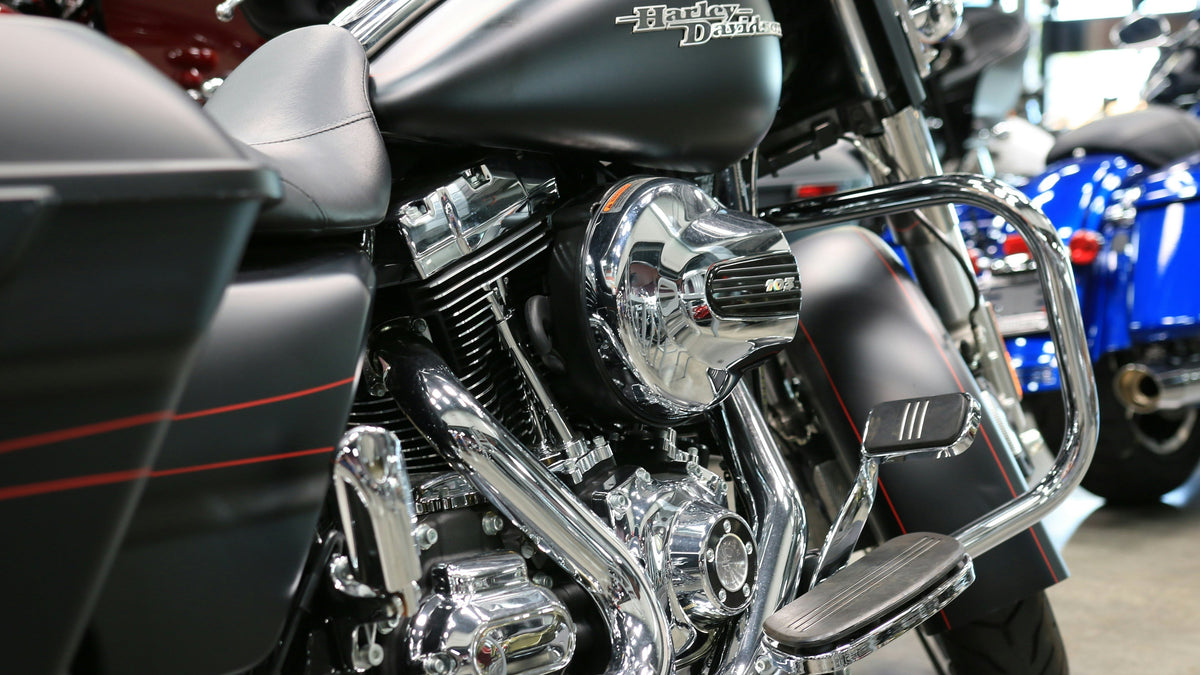
Park a BMW R-series next to a Honda CB and you're not just looking at two machines. You're looking at two answers to a single question: what is a motorcycle supposed to be? One treats it as something with character, something meant to be felt. The other treats it as a tool refined to the point where, once you're riding, you forget it's there. These two answers didn't split apart yesterday. Their roots reach back into two histories that began more than half a century apart.
Understanding that divergence is more useful than comparing spec sheets—because today the specs are increasingly hard to separate. What still separates these bikes is lineage, philosophy, and the kind of rider each one wants you to be.
Origins: Europe invented the motorcycle, and Japan arrived late
The first thing worth admitting is that the motorcycle is a European invention, and a far older one than most people assume.
In 1885, Daimler built what's widely regarded as the first two-wheeler with an internal combustion engine (the Reitwagen, or "riding car"), in Germany. The first true series-production motorcycle you could actually buy was the 1894 Hildebrand & Wolfmüller, also German—it even gave the German language the word Motorrad. In other words, when the motorcycle first appeared as a product, the entire stage was European.
Over the following decades, European brands stepped forward one after another, and each came from somewhere different:
- BMW started in 1916 building aircraft engines. After World War I, the Treaty of Versailles barred it from making aero engines, so it pivoted elsewhere. In 1923 it launched its first motorcycle, the R 32, with a boxer (flat-twin) engine and shaft drive, designed by Max Friz. That layout became BMW's DNA for a hundred years; shaft drive is a signature design feature of BMW's large-displacement and boxer-engine models; until the launch of the F 650 in 1993, BMW produced almost exclusively shaft-driven motorcycles.

By Stahlkocher - Own work, CC BY-SA 3.0 Picture Source
- Moto Guzzi was founded in Italy in 1921 and is the longest continuously producing motorcycle brand in Europe.
- Ducati didn't build motorcycles at all when it was founded in 1926—it made vacuum tubes and electronic components. It turned to two wheels only after WWII, later building its name on near-obsessive racing technology like the desmodromic valve (mechanically forced valve closing).
- Across the Channel, Britain was the industrial heartland of the era. Names like Triumph, Norton, and BSA all but defined what a "big-displacement motorcycle" looked like through the first half of the twentieth century.
And Japan? Essentially absent. Japan's motorcycle industry only got going on the rubble of WWII—more than 20 years behind Europe. And it was precisely that late arrival that set it on a completely different road.
Two roads: one grew out of racetracks and workshops, the other out of rubble and assembly lines
European: character first
Most European brands grew out of a tradition of precision engineering (aviation, machinery, electronics) and racing culture. From the start they had no intention of building "a bike for everyone"—they built machines with distinct personalities. Nothing illustrates this better than their near-stubborn loyalty to particular engine layouts:
- BMW's flat-twin boxer
- Ducati's L-twin / V4, plus desmo
- Triumph's triples
- Moto Guzzi's longitudinally mounted V-twin
Each layout carries its own engineering trade-offs, but the primary reason they exist is identity. The way a boxer shakes between your knees, the sound and pulse of a Ducati twin—these are the product. What European brands sell is a "character" you can feel and identify with, at the cost of higher prices, smaller production runs, and a more selective position in the market.
Japanese: reliability first
Japanese brands came from a far more pragmatic place. They were born into a postwar society rebuilding from nothing, desperate for cheap, reliable transport, and they carried the logic of manufacturing in their bones—consistency, durability, value for money. And most of them came to motorcycles sideways:
- Honda was founded in 1948; Soichiro Honda was an engineer by training. Its first true motorcycle, the Dream D, arrived in 1949. The 1958 Super Cub was a landmark—that little machine went on to become the most-produced motor vehicle in human history, passing 100 million units cumulatively by 2017. Honda became the world's largest motorcycle maker around 1959, and its famous American slogan, "You meet the nicest people on a Honda," reframed the motorcycle from a troublemaker's toy into an everyday object for ordinary people.
- Yamaha only entered motorcycles in 1955. Its parent company, Nippon Gakki, had been making pianos and organs—the metalworking expertise it had built making instruments was put to use building bikes. Its first machine, the YA-1 "Red Dragonfly," was modeled directly on Germany's DKW RT125. Note the detail: in the beginning, the Japanese were learning from Europe.
- Suzuki started out building textile looms.
- Kawasaki came from a heavy-industry world of aircraft, ships, and rolling stock.
Four companies from wildly different origins converged on the same playbook: use manufacturing craft to push reliability and cost to the limit, capture the mass market with small-displacement bikes first, then prove themselves on the track. Honda entered the Isle of Man TT for the first time in 1959 and was winning within a few years; through the 1960s, Japanese factories pressed steadily forward in world Grand Prix racing.

1969: the Japanese won on Europe's home turf
The real turning point was the 1969 Honda CB750. It was the first mass-produced inline-four street bike, with a front disc brake and electric start—features that until then mostly lived on race bikes. More decisive was the price: it launched at around $1,495, while comparable big-displacement bikes commonly sold for $2,500 to $4,000 and up.
In one stroke it did what European brands couldn't: it packed high performance, high refinement, and "starts every time you thumb the button, and you can afford it" into a single machine. The word superbike was coined for it, and it's widely regarded as the original UJM (Universal Japanese Motorcycle).
The consequences were brutal. Through the 1970s, the British motorcycle industry collapsed under the Japanese onslaught. While Royal Enfield had already closed its British factory gates at the turn of the decade, industry giants like BSA and Norton fell one after another in the years that followed, and even Triumph disappeared for a time. It wasn't until the early 1990s, rebuilt by John Bloor in Hinckley, that Triumph returned as an entirely new company. Italy's Ducati likewise passed through repeated financial crises and changes of ownership; today it sits within the Volkswagen Group (by way of Lamborghini).
In other words, European brands were never simply "on top the whole time." They went through a period of nearly being crushed by the Japanese, and then reborn. The European motorcycle world we see today is one that survived, and rethought from scratch exactly what it was selling.
Where the gap has vanished—and where it stubbornly remains
If the question is "are there still big differences today?", the answer comes in three layers.
Layer one: the capability gap has largely disappeared.
IMU-based cornering ABS, traction control, ride modes, quickshifters, big TFT dashboards—these are now near-standard on both sides, and they frequently come from the same suppliers: Bosch electronics, Brembo calipers, Showa / KYB / Öhlins suspension. When the core components themselves can no longer be sorted into "European-made" or "Japanese-made," most of the "feature gap" loses its meaning. Reliability is the same story: the old last-century cliché that "Italian electrics are black magic" simply no longer holds for this generation of BMW or Triumph.
Layer two: the differences remain, but their nature has changed.
Those engine layouts—boxer, L-twin, triple, transverse V—are still vivid today. But the key point is that European factories aren't unable to build an inline-four, and Japanese factories aren't unable to build a triple. This is now a deliberately maintained choice of identity, not a matter of technical superiority. The difference shifted from being a shortcoming to being a selling point. Interestingly, Japanese makers have begun chasing "character" in the other direction—Yamaha's CP3 triple and the way the MT line is tuned for sound and torque feel are Japan making up the very lesson it once cared about least.

Layer three: the "European vs. Japanese" frame itself is breaking down.
The most "European" of brands, KTM, saw its parent company taken fully over by India's Bajaj after a late-2024 restructuring; in early 2026 it was formally renamed Bajaj Mobility AG, with Bajaj holding roughly 74.9%. Add the deep involvement of Chinese capital and manufacturing, and a bike's "bloodline" long ago crossed geography. The axis that actually matters is sliding away from "Europe vs. Japan" and toward "premium, character-led positioning vs. mass-market volume," and "who owns and builds what within a global supply chain."
The one structural difference that has barely moved is the business itself: Japanese makers (Honda especially) still dominate the small- and mid-displacement commuter market across Asia at enormous volume—a segment European brands hardly touch—while European brands skew premium and niche overall. Factor in dealer-network density, parts cost, and resale value—the "whole life of ownership" stuff—and this layer of difference looks much the same today as it did twenty years ago.
The things riders actually weigh
History is interesting, but when you're putting money down to buy and maintain a bike, what you weigh is a handful of concrete things. The ones below are exactly the tangible differences those two roads have left behind today.
One: running costs and parts.
This is the most concrete difference the divergence left behind, and the one most worth building into your budget. Each side's cost structure flows from its positioning. Japanese bikes have dense networks, cheap and easy-to-find parts, and simple routine maintenance—small problems can usually be fixed nearby, and parts don't take long to arrive. European bikes lean more on brand channels and specialist technicians; parts prices and lead times tend to run higher, and specialized service like desmo valve checks takes more labor—all of which is of a piece with a small-volume, precision-oriented approach, and buys you a different set of things you may value. Worth adding: modern European models have stretched their service intervals considerably, so this gap has eased a good deal since twenty years ago. The practical call: if you're a high-mileage commuter sensitive to cost of ownership, put this near the top; if you don't ride hard or often, its weight drops.
Two: looks and design.
This shouldn't be dismissed as "soft"—for a lot of people it's the first reason they buy, and the two sides genuinely lean different ways. European brands generally place design at the core of the product's value: Italian styling (Ducati, Aprilia), BMW's bold and sometimes deliberately provocative design language, Triumph's modern-classic look—these often start by deciding "what this bike should look like and what it should project," then let the engineering follow. The design itself is part of what it asks you to identify with. The Japanese tradition leans more toward function and balance first, with styling serving practicality—though in recent years they've pushed hard into design too, and the visual language of Yamaha's MT line or Kawasaki's Ninja/Z is highly distinctive. The practical call: ask yourself how much weight you'll assign to "how it looks." If you want a stance and attitude you connect with at a glance, European bikes hit that mark often; if you want something that looks good, ages well, and never sacrifices practicality for style, Japanese bikes are a safe bet.
Three: the kind of relationship it wants.
The outright reliability gap between the two is now very small; what really differs is the relationship each wants to have with you. Japanese bikes are mostly designed to "demand little"—get on and go, keep your attention on the road, ideal for treating the bike as a dependable daily companion. European bikes often want you more actively involved and engaged in their care, and treat that involvement as part of the pleasure. This isn't about reliable versus unreliable; it's about "I want it to serve me quietly" versus "I enjoy interacting with it." The practical call: if the bike is your only transport and absolutely has to start every day, lean toward the former; if it's the "bike you wanted" that you ride on weekends, the latter makes complete sense.
Four: resale value and the used market.
This bears directly on your real cost when you trade up in a few years. Japanese bikes generally hold value steadily, move quickly on the used market, and price predictably. European bikes depend more on the specific model and its reputation: marquee models (the BMW GS, certain Ducatis) hold value strongly, while niche models rely more on the local market and the activity of the enthusiast community, and swing more widely. The practical call: if you plan to change bikes every two or three years, build this into your total cost; if you hold long term, it matters less.
Five: where your money lands at a given price.
With a fixed budget, the two sides pull your trade-offs in different directions. Japanese bikes typically put more of the budget into mechanical spec, on-paper performance, and lower running burden—what you're buying is more of "the bike's raw substance." European bikes put a sizeable share of the value into design, brand, sound, and overall feel—what you're buying is more of "wanting to own it." Both are valid; the point is to be clear about which end you're mainly paying for.
One last reminder: stop forcing everything into "European bikes always have soul, Japanese bikes never do." Triumph's triples have character and strong reliability; Yamaha is seriously cultivating emotion; KTM has Indian capital behind it. "Region" is a weaker and weaker signal today. Rank the five things above against your own riding, then go test ride—it'll serve you far better than agonizing over "European or Japanese." Whether a bike is right for you is, in the end, the answer your body gives after you sit on it, twist the throttle, and run a stretch of road you know well.





Leave a comment
All comments are moderated before being published.
This site is protected by hCaptcha and the hCaptcha Privacy Policy and Terms of Service apply.