
















Based on an interview with Daniel, who rides the islands of Nusa Tenggara every year — and keeps coming back for one island in particular.
Some motorcycle trips follow a road. This one follows a chain of islands.
Stretch a map of Indonesia across the table and look east of Bali: Lombok, then Sumbawa, then Flores, stepping-stones of volcanic rock scattered across a turquoise sea. Riding them means stitching ferries and tarmac together, rolling your bike up steel ramps at dawn, watching one island sink behind the wake while the next one rises ahead. From Bali to Larantuka — the easternmost town of Flores — and back, the route runs somewhere between 3,500 and 4,000 kilometers.
That's the trip our rider makes, in one form or another, every single year. And when you hear him tell it, you start to understand why.

The Long Road East
The journey begins gently enough. Out of Bali, a short ferry hop lands you on Lombok — an island that literally wears its food on its name, since lombok means chili in Javanese. The locals take that seriously: the island's signature dish, ayam taliwang, is a small grilled chicken buried under enough chili paste to make a strong rider quietly reach for his water bottle. Consider it a warm-up, in every sense.
Then comes Sumbawa, longer, drier, emptier — a transit island for most travelers, with fast open roads and brown hills rolling past like waves. And at Sumbawa's far end, a longer ferry crossing delivers you to the gateway of the main event: Labuan Bajo, on the western tip of Flores.
Labuan Bajo is best known as the jumping-off point for Komodo National Park, where the world's largest lizards still patrol their islands like it's the Jurassic era. But for a motorcyclist, the town means something else. It's kilometer zero of the Trans-Flores Highway — one of the great island roads of Southeast Asia.

Flores: Flowers, Volcanoes, and a Portuguese Ghost
First, a little history, because Flores doesn't quite fit the Indonesia most people imagine. The name isn't Indonesian at all — it's Portuguese, left behind by sailors who charted this coast in the 16th century and called its eastern cape "Cabo das Flores," the Cape of Flowers. The Portuguese brought more than a name: they brought Catholicism, and it took root so deeply that Flores remains a largely Catholic island in the world's most populous Muslim-majority country. Ride east and the roadside mosques of Lombok gradually give way to hilltop churches and blue-robed statues of the Virgin gazing out over the sea.
Nowhere is that heritage stronger than in Larantuka, the easternmost town on the island and the far turning point of this trip. Tucked under a volcano at the water's edge, Larantuka is famous across Indonesia for its Semana Santa — Holy Week processions that have been held for centuries, when the whole town moves through candlelit streets in one slow, singing river of people. Even outside Easter, the town feels different: quieter, older, a little out of time.
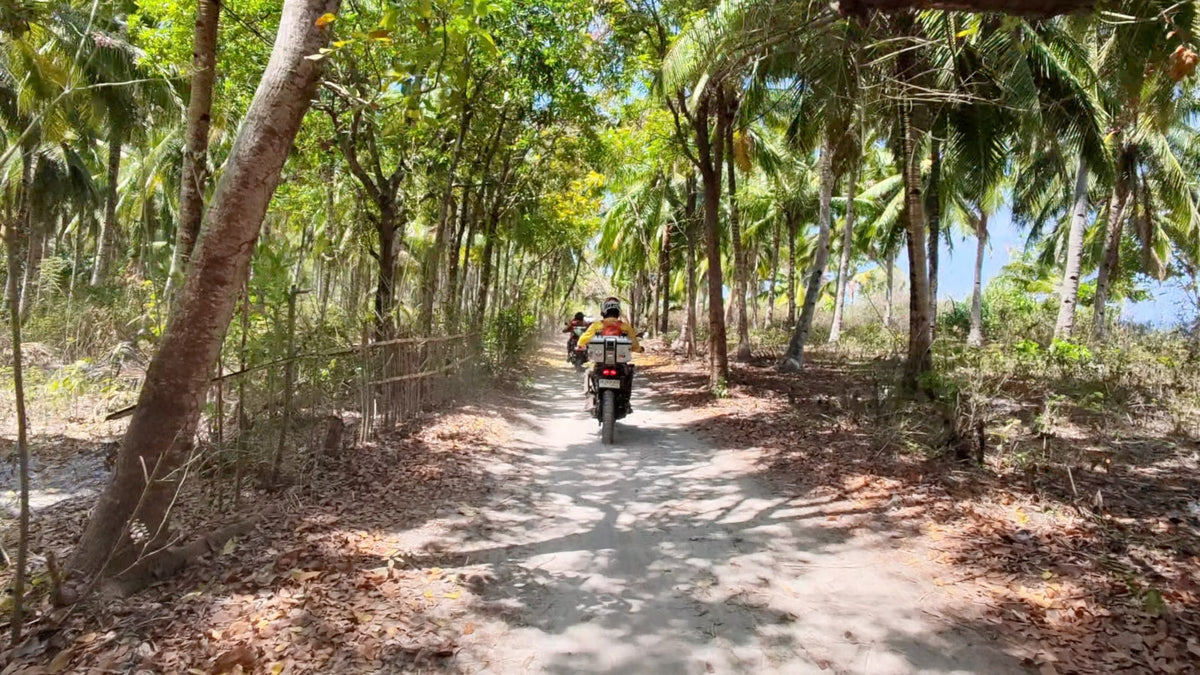
Getting there is the fun part. The riders rolled off the ferry in Labuan Bajo and worked their way across the island — Ruteng, Ende, Maumere, Larantuka — then doubled back through Maumere to the mountain villages of Moni and Riung, on to Bajawa, and finally home to Labuan Bajo. On the map it looks tidy. On the ground, Flores is a rope of hairpins thrown over a line of volcanoes, and the Trans-Flores Highway rarely runs straight for more than a few hundred meters at a time.
"Most of the route was excellent tarmac with a lot of curves — genuinely fun riding," the rider recalls. There were a few loose, off-road-ish stretches too, but nothing dramatic: "more texture than challenge," as he puts it.

The timing helped. They rode at the end of the dry season, when the island bakes gold and brown and the days stay reliably hot and dusty. But Flores plays by mountain rules: climb to Bajawa or Moni, both perched high in the volcanic spine, and the nights turn refreshingly chilly — cool enough to make you dig a fleece out of a pannier you packed for the tropics. As the rider says, "Flores really is a mix depending on elevation."

Moni and the Lakes That Change Color
Moni deserves its own pause. This small mountain town is the base for Kelimutu, one of the strangest volcanoes on Earth. Its summit holds three crater lakes sitting almost side by side — and each lake has its own color, shifting over the years between turquoise, green, rust-red and near-black as the volcano's chemistry changes its mind. Local tradition holds that the lakes are a resting place for departed souls, each lake receiving a different kind of spirit.
Standing up there at sunrise, with cold mountain air in your collar and three impossible colors below you, is the kind of moment that quietly reorganizes your list of favorite places.
Back down in the village, the reward is simpler: hot food and highland coffee. Because here's a thing many riders don't expect — Flores grows some seriously good coffee. The arabica from the Bajawa highlands is prized by roasters far beyond Indonesia, smooth and sweet and best drunk thick and black at a wooden table while the mist rolls past the door. Food on the island keeps to the same honest register: grilled fish and sambal along the coasts, rice and garden vegetables in the hills, and — for the brave, once the bikes are parked for the night — a glass of moke, the local palm brandy that shows up at every celebration.

The Detour That Became the Story
Now for the part of the trip the rider calls the story of the ride.
Between Riung, on the north coast, and Bajawa, up in the mountains, the map offers a short main road of roughly 100 kilometers. The riders chose the long way around instead — about 270 kilometers — "not knowing exactly what to expect."
What they got was an education. The first 150 kilometers were marked as a main road on the map. The surface said otherwise: dirt, deep potholes, loose rock, steep climbs and drops, one after another, hour after hour. The first 40 kilometers alone took four to five hours. By the rider's estimate, they climbed and descended roughly 7,000 meters of elevation across that single stretch, and the whole detour swallowed 12 hours.
"It wasn't off-road in a recreational sense," he says. "It's the real supply road for the villages out there." And that's exactly what made it unforgettable. They shared the track with small delivery trucks grinding up the grades, families stacked three to a scooter, school children walking home in uniform — a road that exists not for adventure tourism but because people out there need it, every day. "Even on adventure bikes, it caught us off guard. Hard, but one of the most memorable parts of the ride."

There's a lesson tucked in there for anyone planning a Flores trip: on this island, the line on the map and the road under your wheels are two different documents. Budget time generously, carry water, and treat every "shortcut" — and every long way around — with respect.
A quieter note from the same corner of the island: Riung, the small coast town where the detour began, was hit hard by a series of earthquakes in August 2026. The riders passed through not long after. It's worth remembering that the villages waving you through are real communities with real struggles — and that a traveler's visit, and a traveler's money, mean more there than almost anywhere else.
The People: Why He Keeps Coming Back
Ask the rider for the single best thing about Flores and he doesn't mention the volcanoes, the lakes, or even the curves.
"Riding through the villages, people come out to wave, and children run to the roadside cheering as you pass — almost like spectators at a race," he says. Stop the bike anywhere, and within minutes there's a small crowd of kids, curious, grinning, full of questions. "Indonesians are friendly everywhere, but the enthusiasm in Flores stood out from anywhere else we've ridden. It's a big part of why I keep going back every year."
And maybe that's the real headline here. You can cross Flores for the road, and the road will not disappoint you. But what pulls a rider back across four islands and two ferry crossings, year after year, isn't asphalt. It's the feeling of riding through a place that seems genuinely happy to see you.
Bajawa makes a fitting last mountain stop for exactly that reason. The town sits in the cool highlands at the heart of Ngada country, where traditional villages of thatched houses still stand around ranks of carved ancestor shrines, and megalithic stones mark ceremonies that long predate any church or mosque. People here live close to their traditions — and they'll happily tell you about them over a cup of that famous local coffee.

From Bajawa, the loop closes: back to Labuan Bajo, back across the ferries, back through Sumbawa's empty hills and Lombok's chili-scented warungs, until Bali's traffic swallows you again and the whole thing starts to feel like something you dreamed.
Until next year, anyway.

FAQ
How far is the motorcycle trip from Bali to Flores?
A round trip from Bali to Larantuka, at the eastern end of Flores, covers roughly 3,500–4,000 km, crossing Lombok and Sumbawa by a combination of roads and inter-island ferries.
Are the roads in Flores good for motorcycles?
The Trans-Flores Highway is mostly well-paved and full of curves — genuinely enjoyable riding. But side roads can be rough supply tracks with dirt, rocks and steep grades, so map distances can be misleading: one 270 km detour took these riders 12 hours.
When is the best time to ride Flores?
The dry season (roughly April to October) offers hot, stable riding weather. Expect dust and strong sun in the lowlands, and pack a warm layer — highland towns like Bajawa and Moni turn chilly at night.























Leave a comment
All comments are moderated before being published.
This site is protected by hCaptcha and the hCaptcha Privacy Policy and Terms of Service apply.